
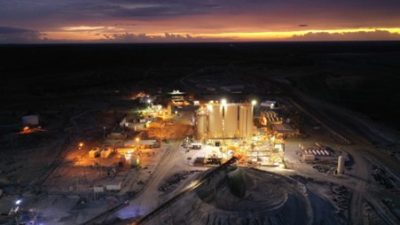
Bruce Rowse, following an interview with Alex Kraan about ISO 50001 at Gold Fields.
Images are © Copyright Gold Fields and are used with permission.
Gold Fields is a multinational gold mining company, operating eight gold mines across South Africa, Ghana, Australia, Chile, and Peru. Four if its mines are in Western Australia. I recently had the pleasure of meeting with Alex Kraan, Australian Unit Manager: Energy and Carbon Manager, to discuss their ISO 50001 experience.

In 2021 Alex oversaw the task of getting the four mines certified to the ISO 50001: 2018 Energy Management Systems standard. This is part of Gold Fields overall commitment to achieve net zero emissions by 2050, and to achieve a 30% reduction in net emissions by 2030, compared to its 2016 baseline.
Gold Fields has strong executive support for its carbon abatement targets, with a Group Climate Change Steering Committee, whose membership includes most of the Group’s executive leadership, driving the achievement of these targets.
Certification to ISO 50001 means ensuing that management systems are in place that minimize the use of energy, and in continually improving both energy performance – that is producing the same outcome but with less energy usage – and also continually improving the management system itself.
Across the Gold Fields Group its energy efficiency initiatives, led by its ISO 50001 Energy Management Systems, are expected to contribute to 12% of the 2030 abatement target, with renewable energy and fuel switching from diesel to electric contributing to the remainder of the target.
In 2023 all four sites achieved ISO 50001 certification, with DNV the independent ISO auditing firm that verified adherence to the standard.

This is an impressive achievement, given that ISO 50001 is relatively new to businesses operating in Australia. Additionally, the mines already operated with reasonably high energy efficiency levels, since energy purchases comprise of around 19% of total operating costs and the business has a culture that traditionally has a strong focus on managing operating expenses.
Reflections on Achieving ISO 50001 at Gold Fields
Reflecting on the journey through to certification, Alex says that whilst ISO 50001 is an energy management standard, in order to meet the requirements of the standard, not only those responsible for the energy side of the business needed to be involved, but also those from maintenance, procurement and processing. A plant that is well maintained and operated is more efficient than one which isn’t. And it is important that the energy efficiency of new assets is considered when purchasing them, particularly considering that some assets, such as large electric motors, could have useful service lives of more than 20 years.
Gold Fields was already certified to ISO 140001 Environmental Management Systems and ISO 27001 Information Security Management Systems, and Alex said he leant quite a bit on the people in the business who ran these systems to assist with establishment of the ISO 50001 at Gold Fields. “Without this expertise, it would have taken longer to become certified to ISO 50001”.
Another challenge came with the deployment of the metering systems needed to be able to measure the energy performance at each site. New meters needed to be specified, purchased, installed, and commissioned, and then dashboards built to enable tracking of the energy performance. The ability to deploy these instrumentation systems really depended on the prior experience in instrumentation of the person nominated at each site, by the site GM, as the ISO 50001 system owner.

In considering the boundary of the ISO 50001 energy management systems, it was decided to have two main Energy Performance Indicators (EnPIs) at each site: energy per tonne of ore crushed, and energy per tonne of ore processed, with boundaries around the crushing plant and the processing plants. Operators of these plants now can track their EnPIs, and the performance trend over time.

Looking back on the experience Alex says that the roll out of ISO 50001 at Gold Fields has been a challenging project. However Gold Fields is committed to cutting its carbon footprint, and the energy efficiency improvements that ISO 50001 drives don’t need the large amount of capital or certainty about the remaining life of the ore deposit that renewable energy projects do.
Getting to net zero emissions is hard to achieve, and in a business which is already reasonably energy efficient, getting further savings from energy efficiency is challenging, but not impossible. Alex concludes by saying “By formally adopting a certified Energy Management System, that is integral to achieving its carbon ambitions, Gold Fields has locked in the cycle of continual improvement that ISO management systems are famous for.”
If you like this article
Read also:
